



Carbide recycling
Saving resources for the future
When a cutting tool loses its cutting properties, that’s not the end — it’s just the beginning. We buy up your worn out tools and other carbide scrap, feed it into our recycling process centre and recover valuable secondary raw materials from it. We use these raw materials to produce new, high-performance tools.
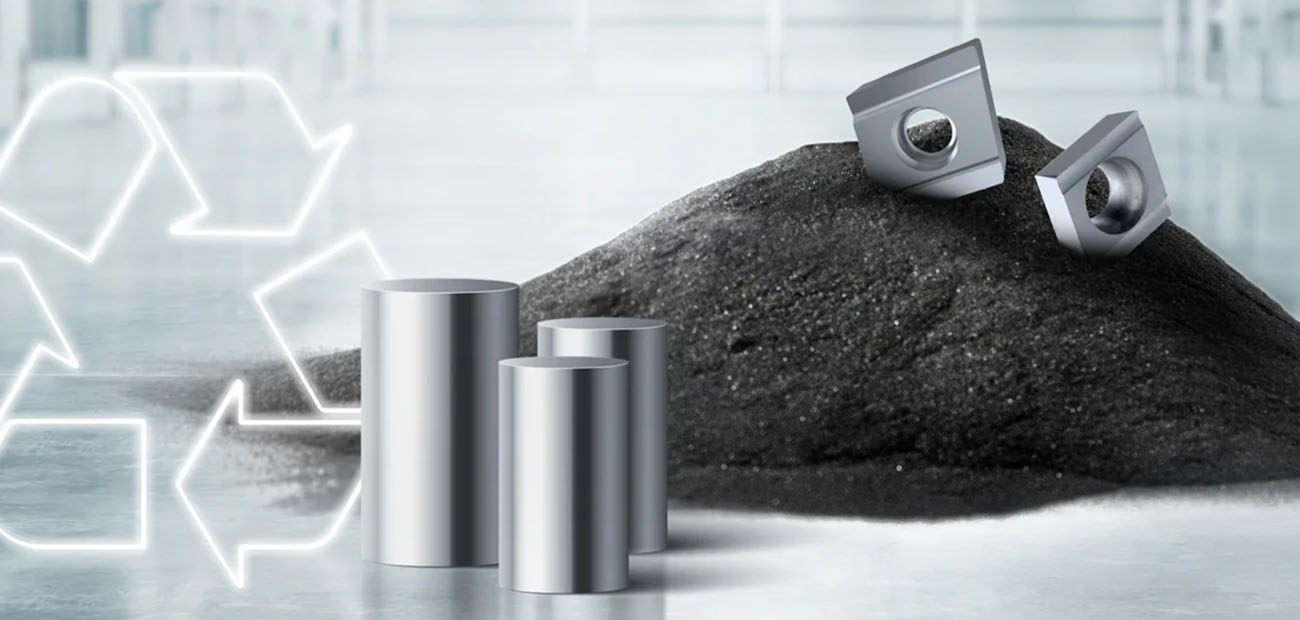
Why recycle carbide?
By carbide recycling, we conserve valuable and, above all, finite primary resources. This is because tool scrap still contains up to 90 per cent tungsten and 10 per cent cobalt.
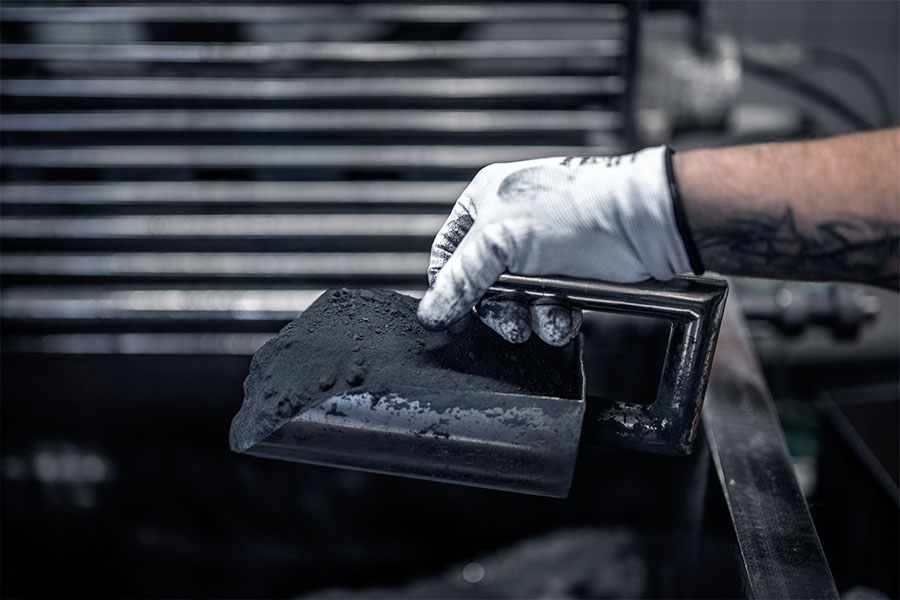
Use high-quality raw materials efficiently
Cobalt in particular is currently one of the most popular raw materials in the world, as it is used to produce lithium-ion batteries, which are indispensable in e-mobility, for example. Tungsten, on the other hand, falls into the category of “conflict materials”. The European Union tightened the import of these conflict materials at the beginning of 2021 because their extraction and trade are particularly harmful to the environment. For example, 250 tonnes of ore have to be mined and processed to produce one tonne of tungsten. These raw materials can be returned to the material cycle through carbide recycling.
Gühring closes the material loop
Today, our blanks already contain over 65 per cent recycled carbide, and the trend is rising. For the quality of the tools, it makes no difference whether they are made from freshly extracted or recycled raw materials. The recycled carbide has the same purity as the so-called virgin powder, which means that the new tools are not subject to any loss of quality. The carbide made from recycled raw materials (grade GC 100 F) has the same performance as 10 per cent submicron carbide – the most important grade group for drilling and milling tools with 70 per cent coverage.

of carbide rods manufactured by the company Gühring KG in Kulmbach.
Our results showed that carbide recycling at Gühring saves 64.8 % CO2
compared to using commercially available carbide powder made from primary materials.
For us, it is clear that switching to secondary raw materials
in carbide production and thus focusing on material cycles represents
the largest lever for reducing CO2 emissions.“
Recycling process
With the help of our own carbide technology and our own recycling plants in Germany, Gühring is able to recover and recycle carbide raw materials. This is why we collect used carbide tools and other carbide parts and process the tungsten contained in the tool scrap into secondary raw materials in powder form by means of zinc recycling. We use this dark grey tungsten powder to sinter new carbide as material for our high-quality cutting tools.
Why zinc recycling?
Carbide can be recycled in two different ways: with zinc process, in which the carbide is converted into powder, and with chemical process, in which cobalt is produced separately as a by-product.
At Gühring, we rely on zinc recycling, as the quality of the recycled tools is significantly higher.
Zinc recycling process
As soon as we receive your worn out tools and scrap metal, they are transported to our recycling facilities to be recycled into powder. In the first step, they are cleaned and crushed into suitable sizes to ensure homogeneous processing. Zinc recycling then takes place in the following steps:
Step 1: Zinc distillation
Heating: The prepared hard metal scrap is placed in a reactor and heated to a temperature of around 900-1000 °C.
Zinc addition: Zinc is added to the heated reactor. The zinc melts and mixes with the carbide.
Phase formation: At these temperatures, the zinc forms a liquid phase with the cobalt, which acts as a binder in the hard metals. The tungsten carbide remains as a solid phase.
Step 2: Cooling & zinc deposition
Cooling: The mixture is cooled slowly. During cooling, the zinc separates from the solid tungsten carbide matrix.
Zinc distillation: The zinc is removed from the mixture by distillation. It is converted into a gaseous state and then liquefied again in a condenser so that it can be reused for further recycling processes.
Step 3: Mechanical post-treatment
Separation: After removing the zinc, a porous tungsten carbide-cobalt framework remains. This material is mechanically treated to standardise the particles and remove any remaining zinc residue.
Powder production: The recycled carbide is converted into powder form, which can then be reused for the production of new carbide products. To do this, the powder is mixed with fresh cobalt and other necessary materials and converted into the desired mould.
Recycling with Gühring
Join us in making a contribution to the environment and become part of the Gühring Tool Circle! You don’t have to worry about a thing, because we organise everything related to carbide scrap for you.
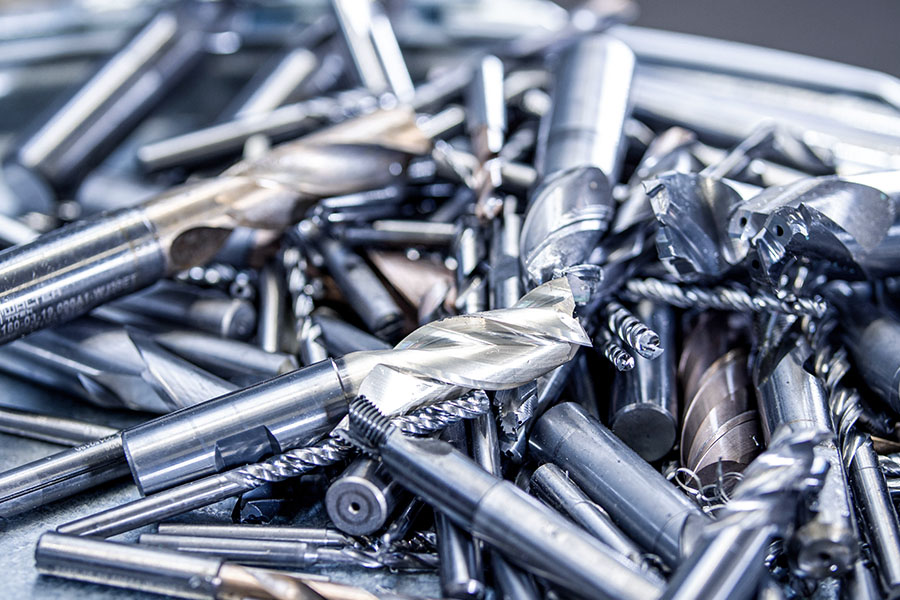
We recycle your carbide scrap
Hand in all worn out indexable inserts, monoblock tools (drills, milling cutters, etc.) or other scrap parts from carbide to us. You can either send the scrap metal to us or have it collected if it weighs 25 kg or more. Whether you originally purchased the tools from Gühring or one of our competitors is irrelevant.
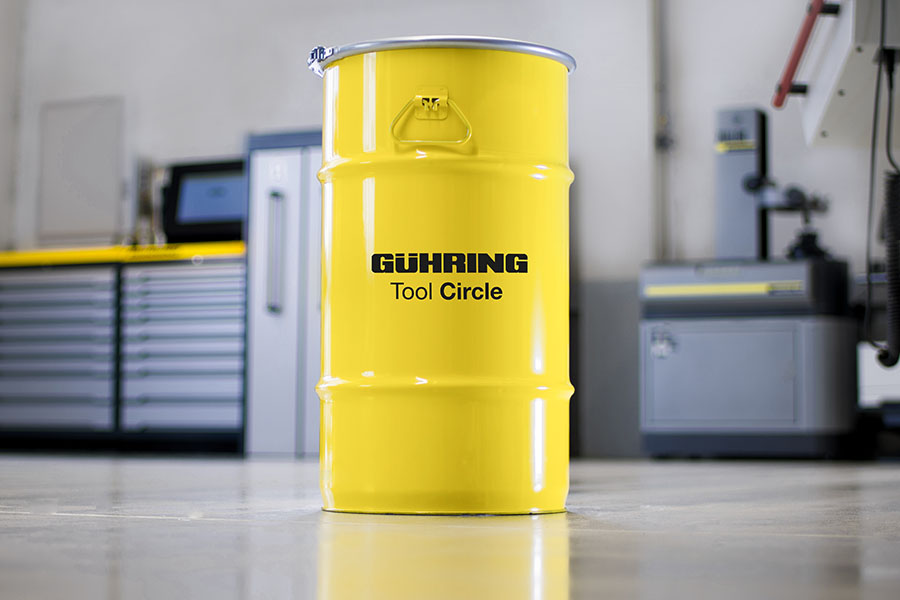
Order your recycling barrel
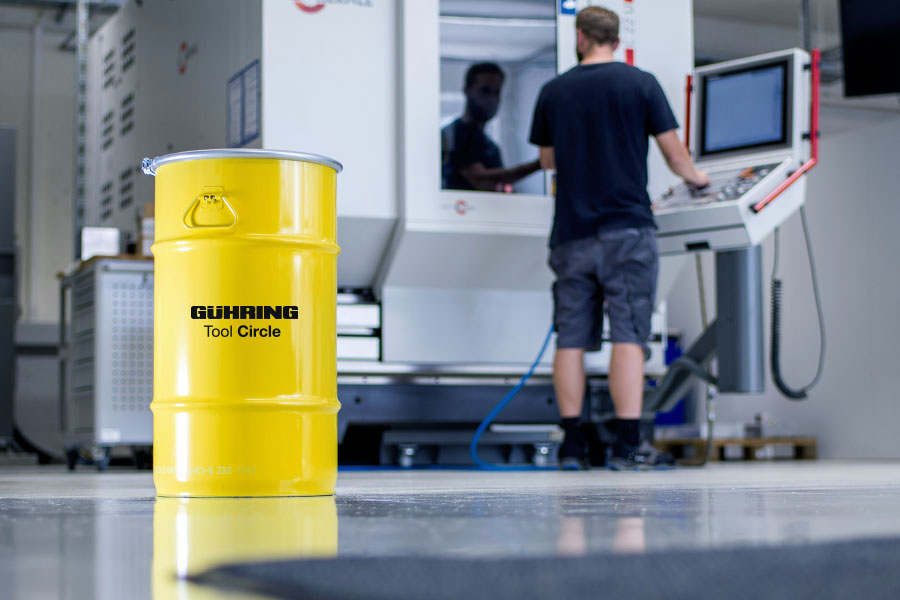
You simply collect your carbide scrap in our yellow barrels, which we provide you with for free. We then buy it back based on the current market price. You can decide for yourself whether you want to send the barrels back to us or have them collected directly from your production by our collection service. Particularly practical: Install a “pick-up button” in your manufacturing, which you can use to automatically notify us as soon as a barrel is to be picked up.
Turn scrap into money
We will check and weigh your carbide scrap and then make you an offer. The exchange amount for your carbide will be credited to your Gühring customer account and can be redeemed for your next tool purchase. Please contact us for a non-binding offer or more information:
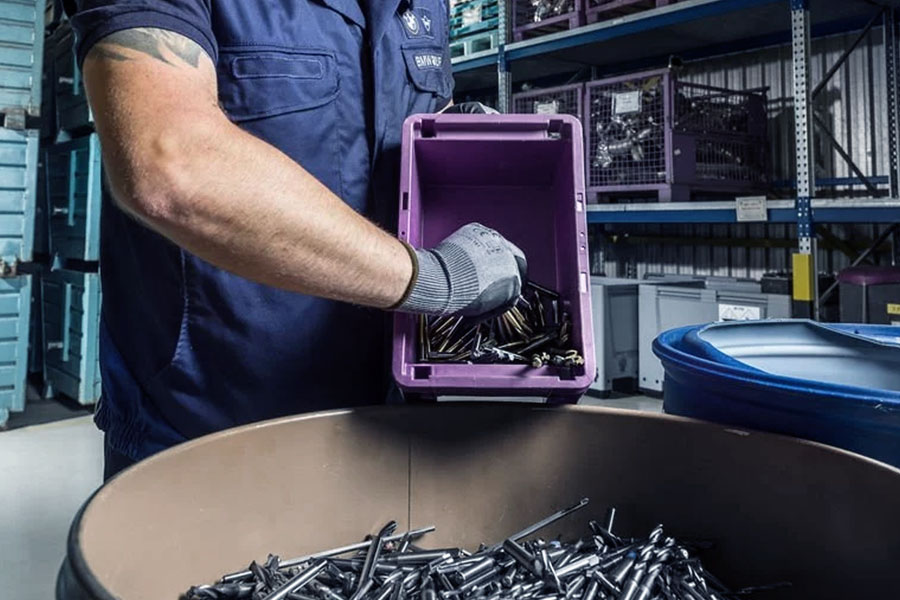
Good role model
Recycling at the BMW Group
One example of how sustainable carbide recycling works is the BMW Group: it already uses drill bits and milling tools containing recycled tungsten. This material cycle has been extended to all BMW plants in Germany and Austria.
Each year, these plants produce almost nine tonnes of scrap from carbide tools, which contain an average of over seven tonnes of recyclable tungsten. Nadine Philipp, Head of Sustainability in supply chain at the BMW Group, says that “every gram counts, for which we can ensure that it conserves natural resources and does not contribute to violations of environmental and social standards.”

 Online shop
Drilling tools
Historically good: our drills set standards
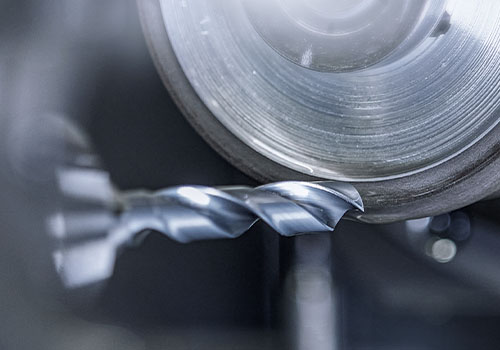
Tool refurbishment
Extend the life of your tools with our professional tool refurbishment service
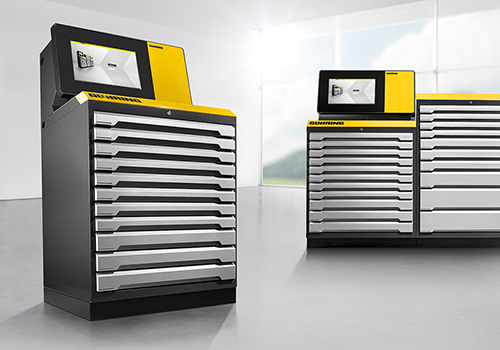
Tool dispensing systems
Hardware for your tool management


