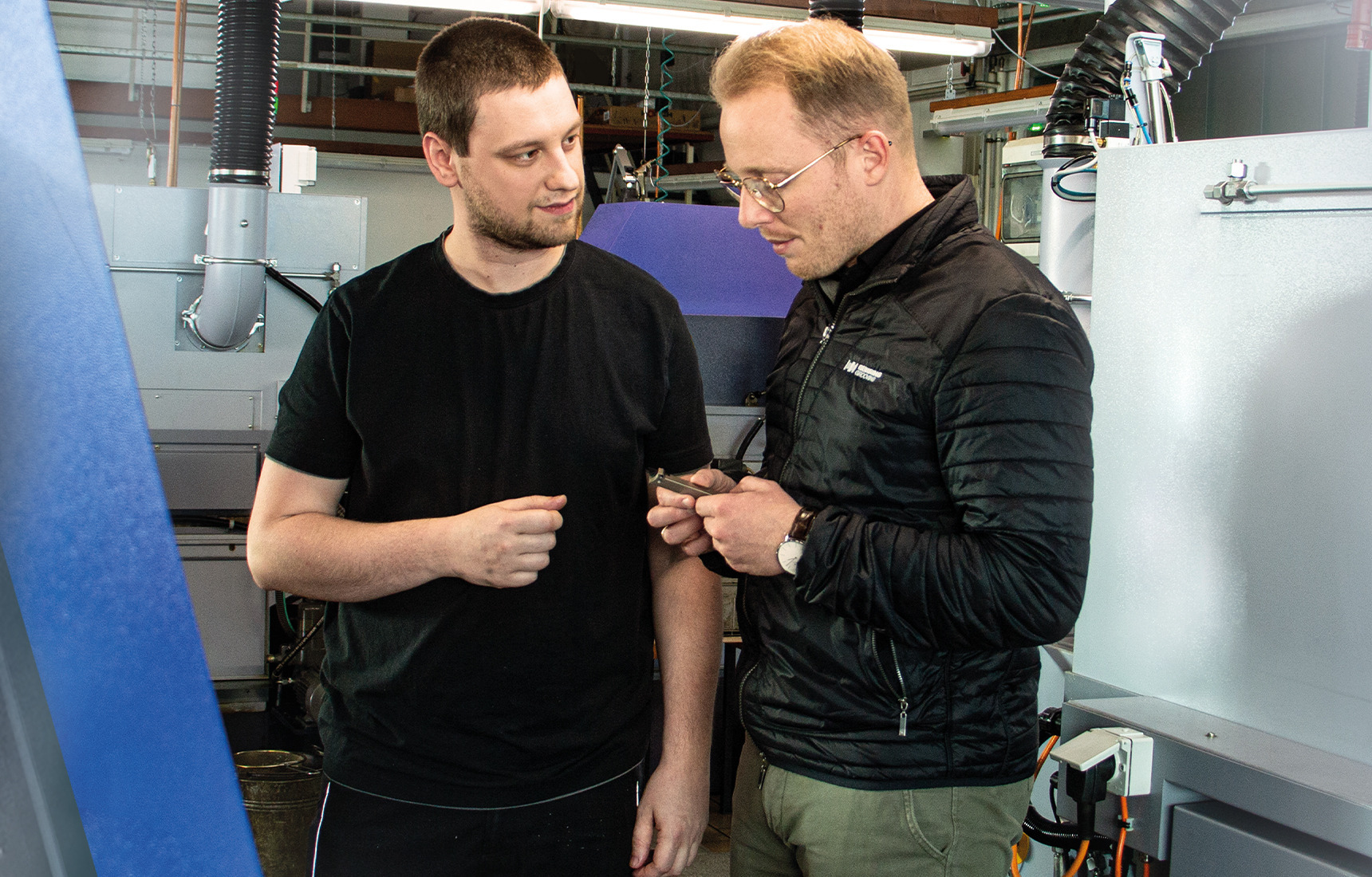
Veile Feindrehteile GmbH was facing a critical bottleneck in stainless steel machining: insufficient tool life, unstable cutting edges and unreliability in unmanned operation. However, close technical cooperation with Gühring led to a tool design that is precisely tailored to the requirements of sliding headstock turning: with the 208 parting off system, the family-owned company not only increases process reliability, but also improves its cost-effectiveness.
In the small town of Bretten near Karlsruhe, Veile Feindrehteile manufactures high-precision components from high-grade steel, brass, steel and aluminium for the electrical industry. The components are produced on sliding headstock lathes that must run unattended for up to ten hours overnight. For Patrick Kratt, director of the family-owned company, one thing is therefore clear: tools must guarantee absolute process reliability. Any vibration, any imprecise cutting edge and any unpredictable risk to service life can cause the machine to stop – and valuable production time to be lost.
However, when performing machining operations on high-alloyed, saltwater- and acid-resistant high-grade steels, the cutting tool used by a competitor showed weaknesses: the cutting edge was very sharp, which led to rapid cutting edge wear in high-grade steel. “I was dissatisfied with the tool life I achieved with the competitor’s tool,” says Kratt. “Especially during the night shift, I lacked the confidence that the machine would really run through.”
Convincing right from the first test
When Gühring product manager Marc Wiesner analysed the problem together with Kratt, it quickly became clear what the new tool had to deliver: maximum tool life, stable cutting edges, smooth cutting behaviour, defined flatness of the parting cut and a geometry that optimally takes into account the forces of the sliding headstock lathe. Fortunately, Gühring had a new solution in its programme that perfectly met these requirements: the 208 parting off system.
The switch was quick, recalls Kratt: “I told the sales representative: I have a problem, I want to improve something. Do you have a solution? We drew up a sketch and angle specifications together, Gühring supplied the right tool – and right from the first test, the plate worked exactly as I wanted it to.”
Designed for greater stability
The 208 system combines a stable cutting edge geometry with targeted cutting edge rounding and Nano-A coating. This coating is thin enough not to distort complex geometries but has sufficient hardness and temperature resistance to significantly increase tool life, especially in high-grade steel.
For Patrick Kratt, the precise adjustment of the cutting edge rounding was crucial. A cutting edge that is too sharp produces defined edges on the component but wears too quickly in hard high-grade steel. On the other hand, a cutting edge that is too blunt increases the cutting forces and overloads the machine. The solution lies in targeted, minimal rounding.
Gühring implements this in the System 208 with high reproducibility. “The cutting edge must not be abrasive in high-grade steel. Thanks to the Nano-A coating and the targeted rounding, the indexable insert harmonises perfectly with the material,” explains Marc Wiesner. “The result is a smooth cut, less wear and a consistently high surface quality.”
Another important point was chip formation. The chip former of the System 208 is designed as a hollow groove and performs chip forming into a spiral-shaped “snail”. This allows the chip to fly into the chip space in a controlled manner – without frictional heat, without jamming and without the risk of chips jamming in the groove. This is crucial for a permanently stable, unmanned process. “I have no heat build-up and no problems with chips getting stuck,” confirms Kratt.
Gühring supplied the right tool – and even during the first test, the plate performed exactly as I wanted it to.
Precise flatness in parting cut
However, it was not only process reliability that played a major role for Kratt, but also the flatness of the parting cut: during parting off, the parting surface is created, which often later serves as a functional surface. It must be flat, without any curvature or recess. The System 208 achieves a very high degree of flatness thanks to its stable projection and constant cutting forces. “My specification was to achieve flatness in the range of one to two hundredths,” says Kratt. “The tool manages this with ease – even for parts that need to be even more precise.”
For automated overnight manufacturing, the parting cut is the critical process step. If the cutter breaks or the parting cut is not complete, the machine stops. This means lost production. Since Veile started using the System 208, this fear has disappeared. “I can be sure that the cutting edge will survive the ten hours overnight. I used to have rejects after the night shift. Today, I can safely take the earnings from the night shift with me,” says Kratt.
Success today, potential tomorrow
For Veile Feindrehteile, the decision has paid off. In high-grade steel, the System 208 delivers stable processes, long tool lives, excellent surfaces and flatness in the parting cut that reliably meets specifications. In addition, thanks to the precise geometry, higher feed rates can be achieved – for a clear cost advantage. And Marc Wiesner sees even more potential for the future, for example in brass and aluminium machining: “Our standard geometry is universal and process reliable. This gives customers like Veile the opportunity to perform different machining operations with minimal set-up effort.” Kratt draws a clear conclusion: “I now have exactly the process I wanted back then. Gühring listened, understood and implemented. For us, that is an enormous advantage.”
Tool Performance Report
| Tool | System 208, type GZ neutral | Competitor |
| Machine | Star long turning machine SR20 | Star long turning machine SR20 |
| Article number | # 304076763 | |
| Material | X 2 CrNiMoN 17 12 | X 2 CrNiMoN 17 12 |
| Diameter (Ø) | 12 mm | 12 mm |
| Cutting speed (vc) | 100 m/min | 100 m/min |
| Feed (f) | 0.05 mm/rev | 0.04 mm/rev |
| Thread depth (ap) | 6 mm | 6 mm |
| Tool life | 1.800 | 1.000 |
Tool lives increased by 80 % and runtime per component reduced