Extending tool life, recovering raw materials, and ultimately providing customers with a cost advantage: Gühring demonstrates how a modern tool cycle works today, and AUMOVIO benefits from it every day. With the Gühring Tool Circle, the technology company effortlessly recycles its carbide scrap back into the cycle and saves on new purchases—a system that simply works reliably.
In Rheinböllen, state-of-the-art brakes for the automotive industry are manufactured on rotary transfer machines. Carbide tools drill holes, cut threads, or mill the contours of the components. As soon as the tools reach the end of their service life, they are sent to the tool maintenance department—specifically to technical support specialists Bernd Rudersdorf and Jörg Spahn.
The two examine each tool closely: Is regrinding still possible? If so, it is sent back to the manufacturer via regular mail, explains Jörg Spahn: “When the tools are dull, we send them to Gühring. There, they are regrinded, recoated, and then returned to us.” This standardized process not only ensures technical stability but also enables AUMOVIO to make reliable cost estimates. An annual agreement covers the costs. This keeps tool prices predictable, regardless of current market fluctuations or short-term procurement cycles.
The process between AUMOVIO and Gühring has been running smoothly and without the need for coordination for over 20 years. The trust in Gühring is simply there, notes Bernd Rudersdorf: “If we have any problem, we contact Gühring and together we make sure things are running smoothly again.”
A “historic” collaboration
According to Bernd Rudersdorf, the partnership between Gühring and AUMOVIO is almost “historic”: “We’ve actually always used Gühring tools—at least for the 35 years that I’ve been aware of it.” AUMOVIO, with 86,000 employees worldwide, was founded in 2025 from the long-established Continental, which has been manufacturing brake components for renowned automakers, among other things, for decades.
As a new line of business, the company also develops and manufactures autonomous mobile robots. The combination of experience, expertise in large-scale production, and continuous development continues to define the site in Rhineland-Palatinate to this day. However, manufacturing challenges have grown over time, which is precisely why regulated and efficient tool cycles are playing an increasingly important role. This is where another key component of the Gühring Tool Circle comes into play: carbide recycling.
The Gühring employees and we make a well-coordinated team. There’s no need for lengthy discussions—everything just runs smoothly, transparently, and professionally.
Carbide Recycling with Gühring – Transparent and Professional
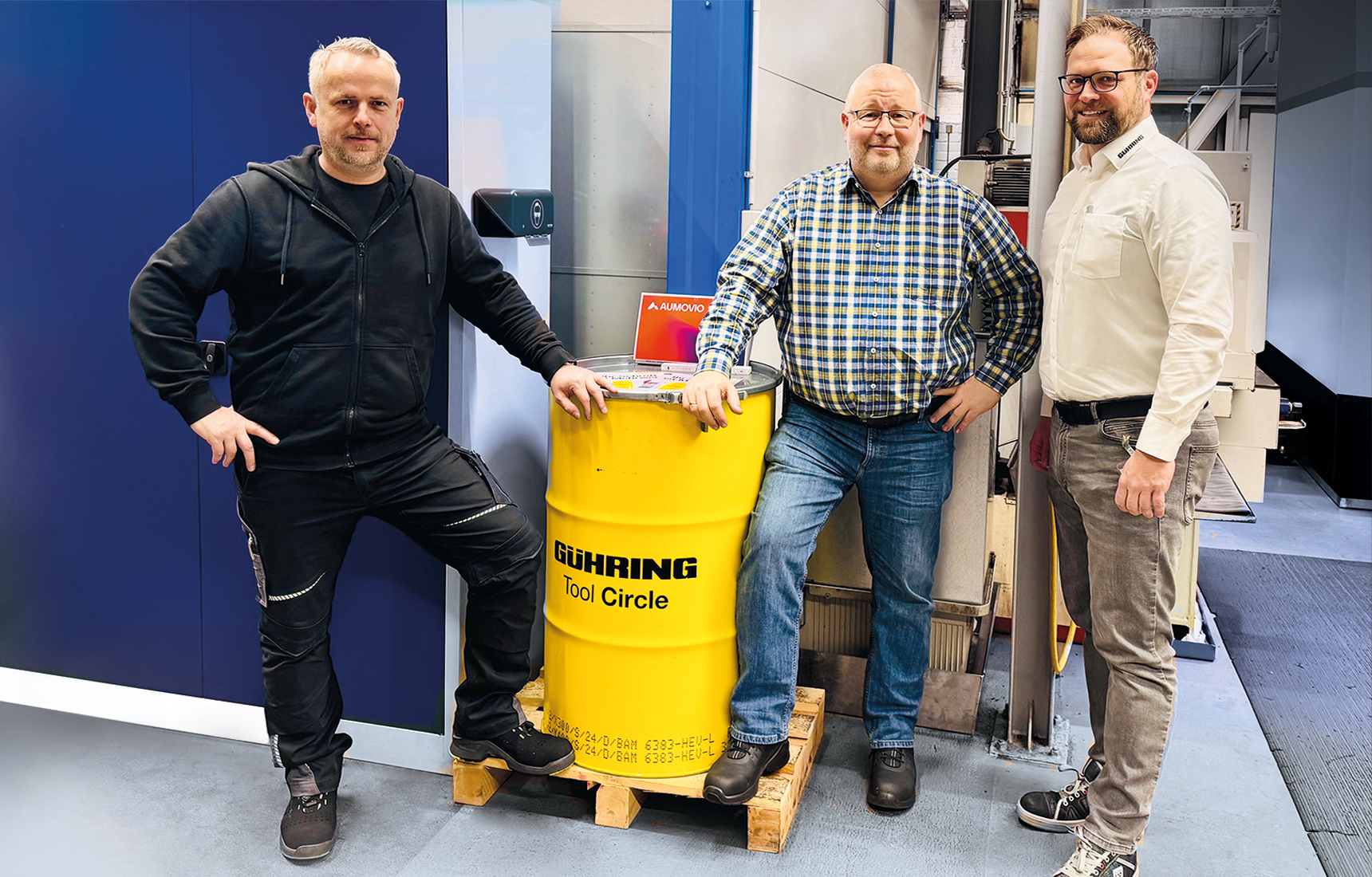
In the tool maintenance area stands a conspicuous yellow drum bearing the word “GÜHRING” in large black letters. This is where all carbide tool scrap from production ends up. Drills, milling cutters, indexable inserts—everything that has reached the end of its life cycle is collected in the container. As soon as the drum is full, AUMOVIO checks the current carbide price and arranges for Gühring to pick it up. Recycling has been handled regularly by Gühring for about five years. Previously, AUMOVIO worked with various trading partners and tool manufacturers.
However, the experiences were mixed. Sometimes prices fluctuated, sometimes the process was confusing, and often quantities and values had to be renegotiated. “We always had to haggle with scrap dealers, and in the end we still felt we could have done better,” recalls Bernd Rudersdorf. AUMOVIO was looking for a solution that would save time and offer greater transparency. In the end, he settled on Gühring. Why? “Gühring has the nicest barrels,” jokes Rudersdorf. In fact, he compared carbide prices across different suppliers and found that the differences were very small. The process with Gühring ultimately won him over.
“The Gühring employees and we are a well-coordinated team. There’s no haggling—it just runs smoothly, transparently, and professionally.” With Gühring’s recycling process, there’s no haggling, as the process follows fixed steps. The filled barrel is picked up and transported to Gühring’s recycling facility in Thurnau, Bavaria. There, Gühring now operates two of its own recycling furnaces and has the largest zinc recycling plant in Germany.
The Tool Circle as a Functioning Cycle
The interplay between regrinding and recycling demonstrates how the tool cycle works in practice within the Gühring Tool Circle. Tools are used, regrinded, reused, and finally recycled, becoming part of the material flow once again as raw material. This creates a cycle that reduces material consumption while simultaneously establishing an economically stable foundation for tool supply. Although AUMOVIO uses its own tool management system, it still fulfills three of the four modules of the overall concept: purchasing new tools, regrinding worn tools, and recycling carbide scrap. Last year, AUMOVIO delivered approximately 700 kilograms of carbide scrap to Gühring for recycling. With the 9% Tool Circle bonus, AUMOVIO receives a refund that contributes to the profitability of its manufacturing operations.
If you have any questions about carbide recycling, please feel free to contact us at any time by phone at +49 7431 17-253 65 or by email at recycling@guehring.de.
You might also be interested in:
Conserving resources for the future: 5 reasons for carbide recycling
Save resources and benefit from carbide recycling with Gühring! Exchange worn tools for money and reduce your carbon footprint. Simple, sustainable and efficient.
The Gühring Tool Circle: Earn money with carbide recycling
Gühring purchases worn tools and other carbide scrap, feeds it into the recycling process and recovers valuable secondary raw materials. Thanks to the bonus model, customers benefit from the Gühring Tool Circle in several ways.